
Makhadeva Jataka
The Tale of the Wise King and the Golden Goose
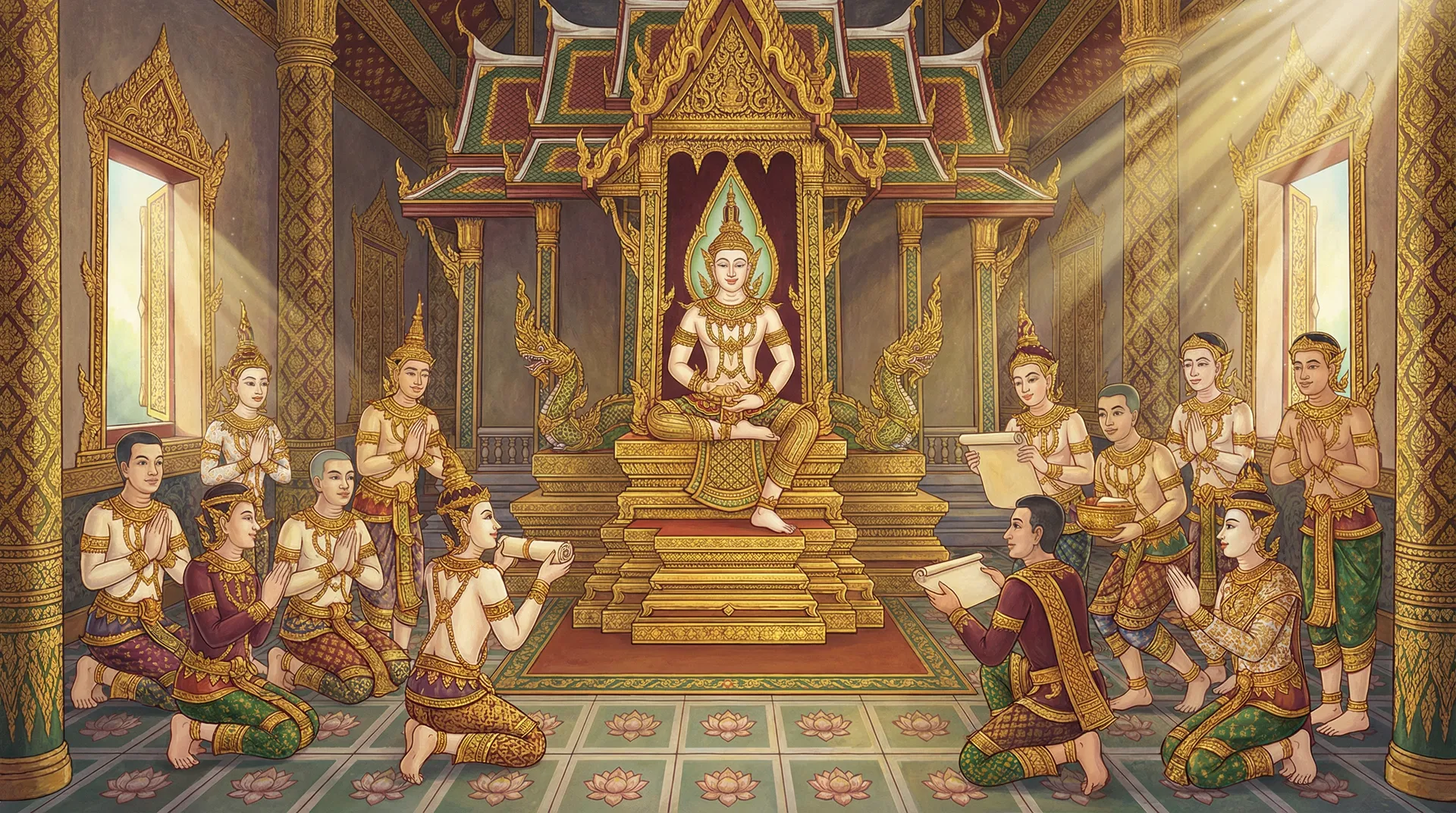
In the ancient city of Mithila, ruled a benevolent king named Makhadeva. He was known throughout the land for his righteousness, his wisdom, and his profound understanding of the impermanence of all things. King Makhadeva had a unique possession: a magnificent golden goose, whose feathers shone like the sun. This goose was no ordinary bird; it was said to be born of magic, and it laid one golden egg every day. The kingdom’s coffers were overflowing with the wealth generated by this wondrous creature, and King Makhadeva was considered one of the richest monarchs in the world.
However, despite his immense wealth and the adoration of his people, King Makhadeva was never truly attached to his riches. He understood that all worldly possessions, no matter how golden, are transient. He spent his days in contemplation, performing his royal duties with fairness, and often reminding his courtiers and his subjects about the fleeting nature of life and fortune.
One day, as he observed the golden goose laying its daily egg, a thought struck him. 'This goose,' he mused, 'provides us with immense wealth. But what if we were to kill it? Then we would have all its gold at once. Surely, that would solve all our problems and ensure the kingdom's prosperity forever.' This thought, though seemingly practical, was born of a momentary lapse in his usual detachment. He called his chief minister, a man known for his shrewdness, and shared his idea.
The chief minister, though initially taken aback, saw the potential for immediate gain. He began to strategize how they might capture and kill the goose to extract all its gold. However, just as they were about to put their plan into action, King Makhadeva was struck by a sudden, sharp realization. He remembered the teachings of the wise hermits he had consulted in his youth, teachings about the dangers of greed and the folly of destroying a source of continuous benefit for a singular, destructive gain.
He immediately stopped the chief minister. 'Wait!' he exclaimed, his voice filled with newfound clarity. 'This is a grave mistake. This golden goose, in its daily bounty, represents a steady, sustainable source of wealth. If we kill it, we gain a hoard of gold, yes, but then the source of our prosperity is gone forever. We will have consumed our future for a fleeting present. Furthermore,' he continued, his gaze thoughtful, 'this goose is a gift, a marvel. To destroy such a unique creature out of greed would be a terrible act, a stain upon our kingdom and our souls.'
The king then addressed his chief minister and the assembled courtiers. 'Let us consider the true nature of wealth. Is it merely the gold we possess, or is it the wisdom to manage what we have and the understanding that true happiness comes not from accumulation, but from contentment and righteous living? This goose, by its very existence and its daily gift, teaches us patience, moderation, and the value of a sustainable path. To destroy it would be to destroy the lesson it offers.'
The chief minister and the courtiers, hearing the king's profound words, were humbled. They realized the short-sightedness of their greedy impulse. They understood that the king's wisdom lay not in possessing great wealth, but in understanding its true worth and the dangers of avarice.
King Makhadeva then made a decree. He ordered that the golden goose be protected and cared for with the utmost respect. He established strict laws against harming the goose or attempting to seize all its gold at once. He also used the daily golden eggs wisely, not for ostentatious displays of wealth, but for charitable works, for supporting scholars, and for the general welfare of his people, always mindful of the impermanence of even this extraordinary gift.
The king continued to rule his kingdom with wisdom and detachment, his reign marked by peace, prosperity, and a deep understanding of the Dharma. The golden goose continued to lay its eggs, a daily reminder of the king’s profound lesson: that true wealth lies in wisdom and contentment, not in the insatiable pursuit of more.
— In-Article Ad —
💡Moral of the Story
True wealth lies not in accumulating possessions, but in wisdom, contentment, and the understanding of impermanence. Greed destroys the source of sustained benefit.
Perfection: Renunciation (Nekkhamma) and Wisdom (Prajna)
— Ad Space (728x90) —
More Jataka Tales You May Enjoy
 518Vīsatinipāta
Sihacampi Jataka
The Lion's Roar of TruthIn the verdant kingdom of Kosala, where emerald forests whispered secrets to...
💡 Courageous honesty and unwavering commitment to truth can overcome internal discord and inspire unity. Selfless service and collective responsibility are the cornerstones of a prosperous and harmonious society.
 262Tikanipāta
Dhammapala Jataka
Dhammapala JatakaIn the ancient kingdom of Kosala, there lived a Bodhisattva who was destined to bec...
💡 Deception and malice can be overcome by truth, integrity, and unwavering virtue. Those who seek to harm others through falsehood will ultimately be exposed and defeated.
72EkanipātaThe Golden Elephant Jataka
In a tranquil land, blessed with lush forests and a clear, flowing river, lived a herd of wild eleph...
💡 Wisdom is found in careful observation, unbiased listening, and the humility to admit one's mistakes.
6EkanipātaThe Compassionate Elephant
The Compassionate ElephantIn the heart of a vast, sun-drenched savanna, where acacia trees dotted th...
💡 True compassion demands the greatest sacrifice, and love can transform the world.
66EkanipātaThe Great Crane Jataka
Long ago, in an age when the Buddha had not yet appeared, in a time immeasurably distant, the Bodhis...
💡 True wealth is measured not by the abundance of possessions, but by the happiness and prosperity of one's people. Greed leads to suffering, while generosity and compassion bring true prosperity.
4EkanipātaThe Tale of the Excellent Archer
The Tale of the Excellent Archer In the ancient kingdom of Mithila, a land blessed with fertile pla...
💡 Accusing others without reason and having impure intentions inevitably lead to one's own suffering. Forgiveness and genuinely good deeds are the path to peace and happiness.
— Multiplex Ad —